

What if you woke up one morning and the internet worked differently? Would you even notice?
A few years ago, as a software developer, I spent a large part of my day doing the same things: reading documentation, searching API references, copying context from one tool to another. Running a database query and pasting the result into another tool. Reading Slack messages and writing code based on that information. I was doing all of it — manually — consuming a huge portion of my mental bandwidth.
In the early months of 2026, I realized most of those habits had become obsolete. Something had changed — quietly, but fundamentally.
That something is called Model Context Protocol.
97 Million Installs — What Does the Number Mean?
In the last week of March 2026, Anthropic announced a number: MCP had reached 97 million monthly installs. From roughly 2 million at its November 2024 launch to 97 million in 16 months. A 4,750% increase.
The number sounds impressive, but what matters more is the picture behind it. OpenAI, Google, Microsoft, AWS, Cloudflare — all began supporting this protocol. The Agentic AI Foundation was established under the Linux Foundation, with MCP as its cornerstone. An ecosystem of 5,800+ community and enterprise MCP servers now covers databases, CRMs, cloud providers, and developer tools.
This is the story of an infrastructure standard, not a single company's product. It resembles how npm packages or the REST API went mainstream — there's no going back.
- 97 million monthly SDK installs (Python + TypeScript)
- 5,800+ community and enterprise MCP servers
- Supported by every major AI provider
- Under Linux Foundation — Agentic AI Foundation umbrella
- 4,750% growth in 16 months since launch
What Does MCP Actually Do? (Non-Technical Explanation)
Think of it this way: you hired an assistant. Smart, fast, tireless. But every morning they walk into the office knowing nothing — where's the password, which database to connect to, which Slack channel is yours, where's the client list. You have to explain everything from scratch every time.
Without MCP, AI tools worked exactly like that. Every session, every query — context zero.
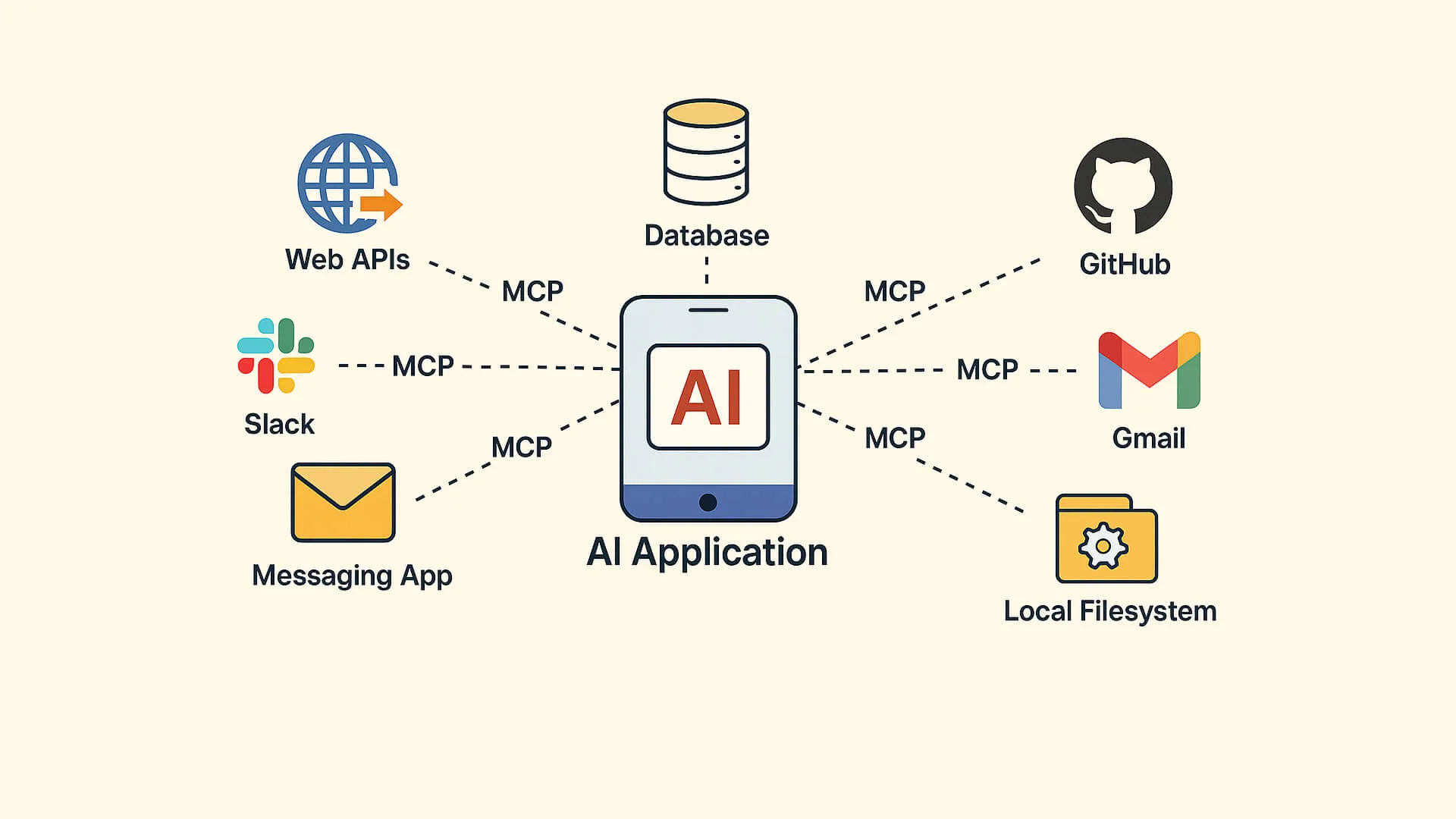
MCP solves this with a standard protocol. You define your tools (database, API, file system, calendar, whatever) as an "MCP server." The AI agent connects to this server, learns what it can do, and executes actions with your permission. Repeatedly. Consistently. Reliably.

To make it concrete for developers, when you write an MCP server today:
- Claude Code can read your GitHub PRs from the terminal and leave comments
- It can connect to your SQL database and run queries
- It can read Slack messages and generate code based on that information
- It can update Jira tickets
- All of this at the same time, in a coordinated fashion
If an agent is doing this instead of you doing it manually, what are you doing? Answering harder questions.
MCP vs A2A — The Protocol Wars Have Begun
Google announced A2A (Agent-to-Agent) in April 2025. Headlines filled with "MCP rival incoming." The reality is more interesting.

| MCP | A2A | |
|---|---|---|
| Created by | Anthropic (Nov. 2024) | Google (Apr. 2025) |
| What it does | Agent → Tool connection (vertical) | Agent → Agent coordination (horizontal) |
| Direction | Connects model to tools | Connects agents to each other |
| Maturity | 18+ months in production | Early stage, limited tooling |
| Install count | 97M (Mar. 2026) | Not disclosed |
| Governance | Linux Foundation (AAIF) | Linux Foundation (since Jun. 2025) |
The reality is that production systems use MCP and A2A together. Each agent connects to its own MCP tools while inter-agent coordination happens over A2A. This isn't "iOS vs Android" — it's more like "WiFi vs Bluetooth." Both are needed, at different layers.
The Tool Wars: Claude Code vs Cursor vs Windsurf
Being a developer in 2026 means: a new tool comes out every month and declares the previous one obsolete. The most efficient pattern I landed on after using all three:

| Tool | Best for | SWE-bench | Context | Price/mo |
|---|---|---|---|---|
| Claude Code | Large refactors, security audits, multi-agent parallel tasks | 79.6% ✅ | 1M tokens | Per Opus plan |
| Cursor | Daily coding, autocomplete, model flexibility | Model-dependent | — | Pro |
| Windsurf | Cascade agentic flow, budget-friendly | Model-dependent | — | Pro / Max |
In my experience, the most productive setup is: Cursor or Windsurf open for daily writing and autocomplete, Claude Code ready in the terminal for big tasks. You don't have to choose — layer them.
Claude Code's 1 million token context window became generally available in March 2026. What does this mean? You can give an entire project — including its dependencies — to the model at once. Instead of "this function in this file," you can ask "why was this architectural decision made in this repo?"
Real-World Production Examples
Numbers are nice, but the "does it actually help me?" question matters more. As of 2026, what are AI agents actually doing in production?

- Banking: 200–2,000% productivity gains in KYC/AML workflows
- Customer service: Receive ticket → verify account → diagnose issue → fix → close ticket — no human, in minutes
- Sales: Agent reactivating dormant leads cut no-show rates by 73%
- Software: Agent works overnight, opens PR by morning, tests passing
According to Gartner, by end of 2026, 40% of enterprise applications will have task-specific AI agents. Last year that figure was below 5%. Already, 65% of companies have automated some workflows with agents.
What Should You Do as a Developer?
I've asked myself this question many times. My answer:
There's no reason to panic. But there's no reason to stay still either.
Learning MCP is like learning a REST API. You're learning today something that will become standard one day — that's the advantage. In the English-speaking developer ecosystem, very few people are covering this topic in depth. Those who get in early own the niche.
My suggested starting sequence:
- Grasp the MCP concept — read the official docs, build an MCP server
- Install Claude Code — try it on a project from the terminal
- Target a small automation — try solving a workflow with an agent
- Understand MCP vs A2A — useful in architectural decisions
- Explain it to your team — being able to explain this in 2026 is valuable
Final Word
The internet once existed without HTTP. Then HTTP arrived and everything changed. Applications once existed without REST APIs. Then REST arrived and everything changed.
MCP is probably in the same category. It started slow, then suddenly it was everywhere. 97 million installs is the signal that we've reached that "everywhere" point.
I asked at the start: what if the internet worked differently when you woke up? The answer: it does. You just need to look a little carefully to notice.



Comments (0)
No comments yet. Be the first to comment.